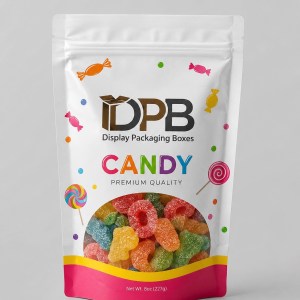
Having trouble finding a way to package your product and still have it fresh? Flat, generic bags conceal the volume of the products and do not attract attention on the shelf. Our Pillow Pouch… Read more →
An unattractive two dimensional package does not encourage a customer to pick it. A center or fin seal rounds out and makes pillow pouches plump and once filled the two layers of film are pulled together at the center creating an even shape to it.
A center or fin seal is what gives pillow pouches their rounded, plump shape, once filled the two layers of film are pulled together at the center seam to form a fin seal pouch with an even consistent shape. This shape is inherently volumetric and thus the snacks, candy, coffee and dried goods appear to be fuller and more attractive on a retail shelf. Stronger shelf presence is often observed with brands as opposed to flat pouches of the same size.
Each product requires various sizing, film thickness, and print detail to be unique. A custom pillow pouch bag allows you to decide on width, length and barrier strength to have packaging that fits your product rather than an off-the-shelf size. Display Packaging Boxes is designed to your precise specifications, creating layers of film and print finish to what your product requires to keep itself fresh and to be appealing to the eye.
Shelf appeal depends on more than just artwork. Pillow pouch packaging is an all around rounded surface that reflects light and attracts the eye more than a flat bag resting against a shelf. The curved surface ensures high resolution printing on the entire surface making logos and product photography visible from different angles enabling a shopper to have a clear view of the brand even when standing at any angle in the aisle.
All pillow pouches cannot be used equally, and it is important to match the appropriate style with a product. Dry goods that are shelf stable require a fully sealed pouch and those that require a resealable closure can be used again after opening. The size range is also diverse with small one serving portions and larger multi serving bags of bulk snack and grain products.
Consumable products that customers use over several sittings require a seal more than once. A pillow pouch with zipper can be placed on the top of the bag to ensure a resealable track, allowing the customer to close the bag securely after every use to preserve the contents. The latter is particularly effective with snacks, pet snacks and bulk products in which freshness should extend far longer than the initial opening.
The name pillow pouch describes the shape; fin seal bags describe how it’s made. Two film webs are sealed together at a center back seam then cross sealed at the top and bottom. This construction gives pillow pouches their rounded, shelf friendly profile and sets them apart from side seal or standup pouch formats.
Making the correct film structure influences the shelf life and the print appearance. The most popular pillow pouch options are as follows:
The size of the pouch has more than just a fit impact; it has a direct impact on protection in handling. Accurate width and length measurements prevent unnecessary air cavities that allow products to move and rest out of place in the bag. The proper thickness of the film inhibits puncture by sharp or granular materials
In addition to sizing, the general shape and style of a pouch can greatly affect its durability in the long term, whether it is being displayed or on the retail shelf. Seam reinforcement and right gusset depth keep the pouch in its shape, even with denser products, without sagging or collapsing. Ensuring that the correct build is used for custom packaging also minimizes the chances of failure of the seal due to repeated handling which helps to keep the product protected from the time it is filled until the time of use. Consistent seam strength is especially important in fin seal packaging where the back seam runs the full length of the pouch and takes on more stress during handling than the shorter cross seals.
Time consuming packaging schedules postpone product rollouts and sales. Standard orders pass through the film selection and printing and pouch conversion on a predetermined timetable that is geared towards the retail and e-commerce deadlines. Brands with tight deadlines to launch or sudden demand spikes have rush production options. All batches are quality checked and that way, speedy delivery has never affected the seal strength or the accuracy of the print.
Smaller brands simply may not be able to invest in huge production runs at the moment. Adjustable minimum order quantities allow a business to experiment with a new pouch design and increase production when sales warrant a higher commitment. This will ensure that upfront costs remain within control and yet the film quality and print resolution is the same as on much larger orders.
Brands that invest in packaging with recyclable or less plastic packaging see better sales, as more consumers are getting fed up with brands that do not pay attention to this. pillow pouches that feature kraft based films, mono material structures and thinner, high barrier laminates meet that requirement without sacrificing seal or barrier properties. Green alternatives are another means of communicating brand values on the shelf and are becoming a more pivotal part of the purchase decision for the increasingly “green” consumer in comparing products from different brands.
One of the most important factors to consider when choosing a pillow pouch bag is how the consumers are going to use the product once it’s opened. Single-use products can be okay with a standard, closed product, while snacks or bulk products can benefit from a resealable, zipper-type closure. The shape of products on the retail shelf has a more round shape that stands for volume, while products that are shipping based will need a flatter shape that will fit into a tight case.
Some brands fail to consider the impact film thickness has on durability during shipping and handling with pillow pouch packaging. Opting to take the thinnest possible to reduce expenses results in punctures, seal failures and reorders that are expensive. A common mistake is not taking a physical sample until after full production because the look of the print colors and film texture is often different on a screen proof than it will be on a physical sample.
Scaling up a product line involves keeping the product line pouches the same across all reorders and retailers. Standardised film specs and print files are a great help with repeat orders, not requiring renegotiation with film size or artwork each time. In the longer term, reliable packaging can lead to larger retail accounts, and even to long-term packaging contracts, for wholesale customers who also expect quality packaging and print quality for all their orders.
When the order volumes start to ramp up, brands require a supplier that can keep up with them without compromising consistency. Pillow pouches with zippers enable the growing business to gain better pricing, whereas at the same time the film quality, seal strength, and print accuracy will be the same for each batch. This reliable supply chain enables retailers to increase their orders and make them more frequent and bigger, which can lead to longer-term orders with brands and boost their distribution network.
Your product should be packaged in a way that closes well, printing is correct, and it withstands all the shipping and shelf-showing conditions. Whether it was the choice of film to use or the final print, Display Packaging Boxes does everything to ensure that your pouch is launched on time and functions as expected. Ask us to provide a quote, take your specification, and accept a proof before you decide to go into full production.
The majority of pillow pouches are flat or slightly tilted as opposed to being entirely upright as a stand up pouch. They are usually presented in a flat, stacked or hung format using a header card and a hole punch by retailers.
The size typically starts with small one serve sizes of about 2 ounces to large multi serving bags of over 5 pounds. Precise sizes are based on the density of products and the strength of the film desired.
Zipper tracks with good quality normally last dozens of open and close cycles without being lost. The thickness of the film and the position of the zipper will determine the longevity of the closure being in full operation.
Minimum run quantities depend on the size and complexity of the print but smaller test runs can be used when launching a new product. When the orders are large then per unit cost is usually lower.
Yes, the choice of films influences appropriateness more than does the pouch shape. The metallized film or high barrier film is suitable with semi-moist products whereas regular film is suitable with fully dry goods.
Transparent pricing, consistent quality, and a team that actually picks up the phone.
Transparent pricing every time — you get exactly what you order, nothing buried.
Review and approve your design, and request modifications before full production.
Get free samples and 3D mock-ups of your exact style, size, and finish first.
High-quality packaging at competitive rates without exceeding your budget.
Submit the quote form, define your requirements, and order within minutes.
Strong materials keep your packaging safe and professional every single order.
Planning and quality control of your bulk orders coordinated end to end.
Stay updated through production so you always know where your order stands.
Everything about this product — from materials to delivery.
Send your product, size, and quantity — pricing back within 24 hours.
We create a digital proof or 3D mock-up for you to approve.
Approved artwork goes to print with precision die-cutting & finishing.
Flat-packed and shipped in 3–4 business days, ready for shelves.
Add 0.125" bleed on all sides; keep text 0.125" inside the trim line.
Supply artwork at 300 DPI at final size for crisp, clean printing.
Set files to CMYK; provide Pantone (PMS) codes for exact brand colors.
Send print-ready PDF, AI, or EPS with fonts outlined and a dieline layer.